All work
AI Concierge
AI Concierge
AI Concierge
Designing a conversational assistant that helps residents get things done faster while reducing manual work for staff.
Designing a conversational assistant that helps residents get things done faster while reducing manual work for staff.
Designing a conversational assistant that helps residents get things done faster while reducing manual work for staff.
Client
BuildingLink
Role
Lead product designer, product management
Lead product designer
Product management
Type
Proptech SaaS, Conversational AI
Proptech SaaS
AI-augmented design
Client
BuildingLink
Role
Lead product designer
Type
Proptech SaaS
AI-augmented design

BuildingLink helps property managers, developers, and condominium boards across the globe deliver a superior resident experience while streamlining maintenance and operations. As part of a small product team, I helped design an AI concierge chatbot built into BuildingLink's resident app, giving residents a single conversational front door for the tasks they used to dig through menus to find: paying rent, reserving an amenity, requesting maintenance, getting a parking permit, and much more.
Where AI fit into my process
Where AI fit into my process
I leaned on AI-assisted design tools throughout ideation, wireframing, and prototyping, spinning up and comparing layout directions, rough wireframes, polished mockups, and user-flow diagrams in a fraction of the usual time. That meant structural decisions got made against real options instead of a single point of view, and left more room for the usability testing and edge-case work that actually needed a human.
Challenges and solutions
Challenge
Challenge
Residents buried in menus
Residents buried in menus
Finding the right form for a routine task meant digging through several layers of the app. Most residents gave up and called the front desk instead.
Challenge
AI screens that don't look like the product
A resident filling out a generic maintenance form often skips the specifics: what's actually wrong, how urgent it is, etc. This leaves maintenance staff to call back searching for more answers before they can even schedule the job. Even worse, the maintenance staff shows up unprepared.
Solution
Figma MCP plus a design system Claude understands
Claude built screens with real BuildingLink components and tokens, with loading, empty, error, and permission states included.
Solution
Solution
One conversational front door
One conversational front door
Residents can now just say what they need. The assistant surfaces the right task (payment, amenity, maintenance, parking) in one message instead of a multi-tap menu hunt.

Challenge
Challenge
Challenge
A one-size-fits-all task list
A one-size-fits-all task list
The original flat list of options treated every resident the same, regardless of what they actually tend to ask for.
Solution
Solution
Solution
A menu that flexes to how residents ask
A menu that flexes to how residents ask
I explored and tested multiple layouts: a scannable icon grid, and options grouped by intent (requests vs. amenities & community) so the assistant's structure matches how residents actually think about their to-dos.


Challenge
Challenge
Solution
Repair requests missing the details maintenance actually needs
Repair requests missing the details maintenance actually needs
Requesting and comparing bids happened entirely outside the system.
A resident filling out a generic maintenance form often skips the specifics: what's actually wrong, how urgent it is, etc. This leaves maintenance staff to call back searching for more answers before they can even schedule the job. Even worse, the maintenance staff shows up unprepared.
Solution
A guided bid flow with a no-login vendor page
Property managers request bids from the project. Vendors respond through a simple link with no account needed. Bids are compared side by side, and a winner is picked in one click.
Solution
Solution
A guided conversation that gets it right the first time
A guided conversation that gets it right the first time
The assistant walks residents through category, a plain-language description, and urgency in a few taps. Then confirms their contact info before submitting, so maintenance receives a complete, accurate request without a single callback.


Challenge
Challenge
Solution
Booking an amenity meant guessing at availability
Booking an amenity meant guessing at availability
Requesting and comparing bids happened entirely outside the system.
Residents browsing a static amenity list had no idea what was actually open: they'd pick a date, submit a request, and wait to hear back before finding out whether it worked
Solution
A guided bid flow with a no-login vendor page
Property managers request bids from the project. Vendors respond through a simple link with no account needed. Bids are compared side by side, and a winner is picked in one click.
Solution
Solution
Real-time availability, in plain language
Real-time availability, in plain language
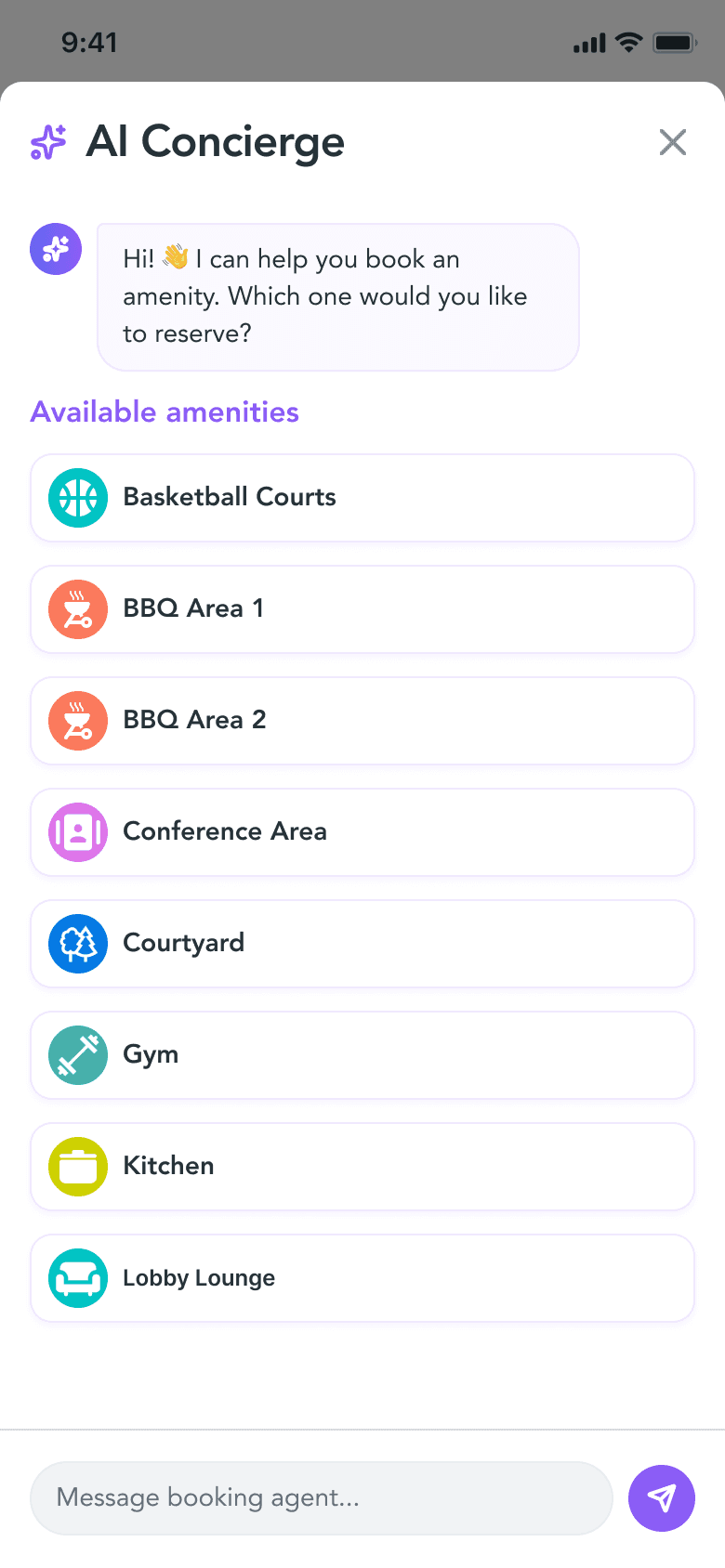
The assistant shows photos, hours, location, and capacity right in the conversation, understands a request like "this Saturday afternoon," and only offers the time slots that are actually free so residents land on a confirmed booking in a few taps instead of the trial and error of submitting and waiting.


“Our front desk used to spend half the day walking residents through the same requests over and over. Now residents just ask the assistant and it's done. We've gotten real time back to focus on things that actually need a person.”
“Our front desk used to spend half the day walking residents through the same requests over and over. Now residents just ask the assistant and it's done. We've gotten real time back to focus on things that actually need a person.”
Property manager in Miami
Key measurements
35% decrease in front desk call volume
35% decrease in front desk call volume
35% decrease in front desk call volume
68% of routine requests resolved via self-service on first attempt
68% of routine requests resolved via self-service on first attempt
68% of routine requests resolved via self-service on first attempt
41% increase in resident app engagement
41% increase in resident app engagement
41% increase in resident app engagement
Challenges and solutions
Challenge
Residents buried in menus
Finding the right form for a routine task meant digging through several layers of the app. Most residents gave up and called the front desk instead.
Solution
One conversational front door
One conversational front door
Residents can now just say what they need. The assistant surfaces the right task (payment, amenity, maintenance, parking) in one message instead of a multi-tap menu hunt.
Challenge
A one-size-fits-all task list
A one-size-fits-all task list
The original flat list of options treated every resident the same, regardless of what they actually tend to ask for.
Solution
A menu that flexes to how residents ask
A menu that flexes to how residents ask
I explored and tested multiple layouts: a scannable icon grid, and options grouped by intent (requests vs. amenities & community) so the assistant's structure matches how residents actually think about their to-dos.
Challenge
Repair requests missing the details maintenance actually needs
Repair requests missing the details maintenance actually needs
A resident filling out a generic maintenance form often skips the specifics: what's actually wrong, how urgent it is, etc. This leaves maintenance staff to call back searching for more answers before they can even schedule the job. Even worse, the maintenance staff shows up unprepared.
Solution
A guided conversation that gets it right the first time
A guided conversation that gets it right the first time
The assistant walks residents through category, a plain-language description, and urgency in a few taps. Then confirms their contact info before submitting, so maintenance receives a complete, accurate request without a single callback.
Challenge
Booking an amenity meant guessing at availability
Booking an amenity meant guessing at availability
Residents browsing a static amenity list had no idea what was actually open: they'd pick a date, submit a request, and wait to hear back before finding out whether it worked
Solution
Real-time availability, in plain language
Real-time availability, in plain language
The assistant shows photos, hours, location, and capacity right in the conversation, understands a request like "this Saturday afternoon," and only offers the time slots that are actually free so residents land on a confirmed booking in a few taps instead of the trial and error of submitting and waiting.
“Our front desk used to spend half the day walking residents through the same requests over and over. Now residents just ask the assistant and it's done. We've gotten real time back to focus on things that actually need a person.”
Property manager in Miami
Key measurements
35% decrease in front desk call volume
68% of routine requests resolved via self-service on first attempt
41% increase in resident app engagement
© 2026 Brian Needles. Designed in Philadelphia.